

Table of Contents

What if your next property investment could practically pick itself, market trends were predicted before they happened, and listings found a buyer faster than ever? AI in real estate is now transforming how investors, agents, and lenders make decisions in 2025. With nearly all industry experts showing interest in AI—only about 3% reporting no interest—these tools are quickly becoming essential for staying ahead.
With AI-driven tools, you can skip tedious tasks like CMA research, MLS cross-referencing, and competitor tracking, while still providing valuable guidance and smarter valuations. In this post, we’ll explore key AI trends, how they impact different players in the industry, practical tips for leveraging AI, and a look at what the future holds beyond 2025.
Key Takeaways
- Real estate professionals can use AI to analyze market trends, valuations, and buyer behavior in seconds instead of hours.
- From lead qualification to document review, AI streamlines time-consuming tasks so teams can focus on growth.
- Forecasting tools empower investors, agents, and lenders to anticipate market shifts and move confidently.
What AI Means in the Real Estate Industry
AI in real estate refers to systems and tools that can analyze data, recognize patterns, and make predictions to support decisions. Unlike traditional methods, AI can process vast amounts of information in seconds, helping professionals tap into insights that would take humans much longer to identify.
Key components of using AI in real estate include:
- Machine learning: Algorithms that learn from historical data to improve predictions over time, such as property valuations or buyer behavior
- Predictive modeling: Tools that forecast housing market trends in sales, inventory, and pricing, helping investors and agents anticipate market shifts
- Automation: Streamlining routine tasks like lead qualification, document processing, and client communications to save time and reduce errors
AI impacts multiple areas of the industry, from pricing and valuations to marketing and customer experience, laying the foundation for more seamless home purchases.
AI Trends in Real Estate
Real estate professionals no longer have to rely solely on intuition or spreadsheets; intelligent systems are analyzing market behavior, identifying patterns, and offering an edge.
Here are a few of the top AI trends helping agents, investors, and lenders access faster insights and make data-driven decisions.
The Rise of AI-Powered Property Valuation
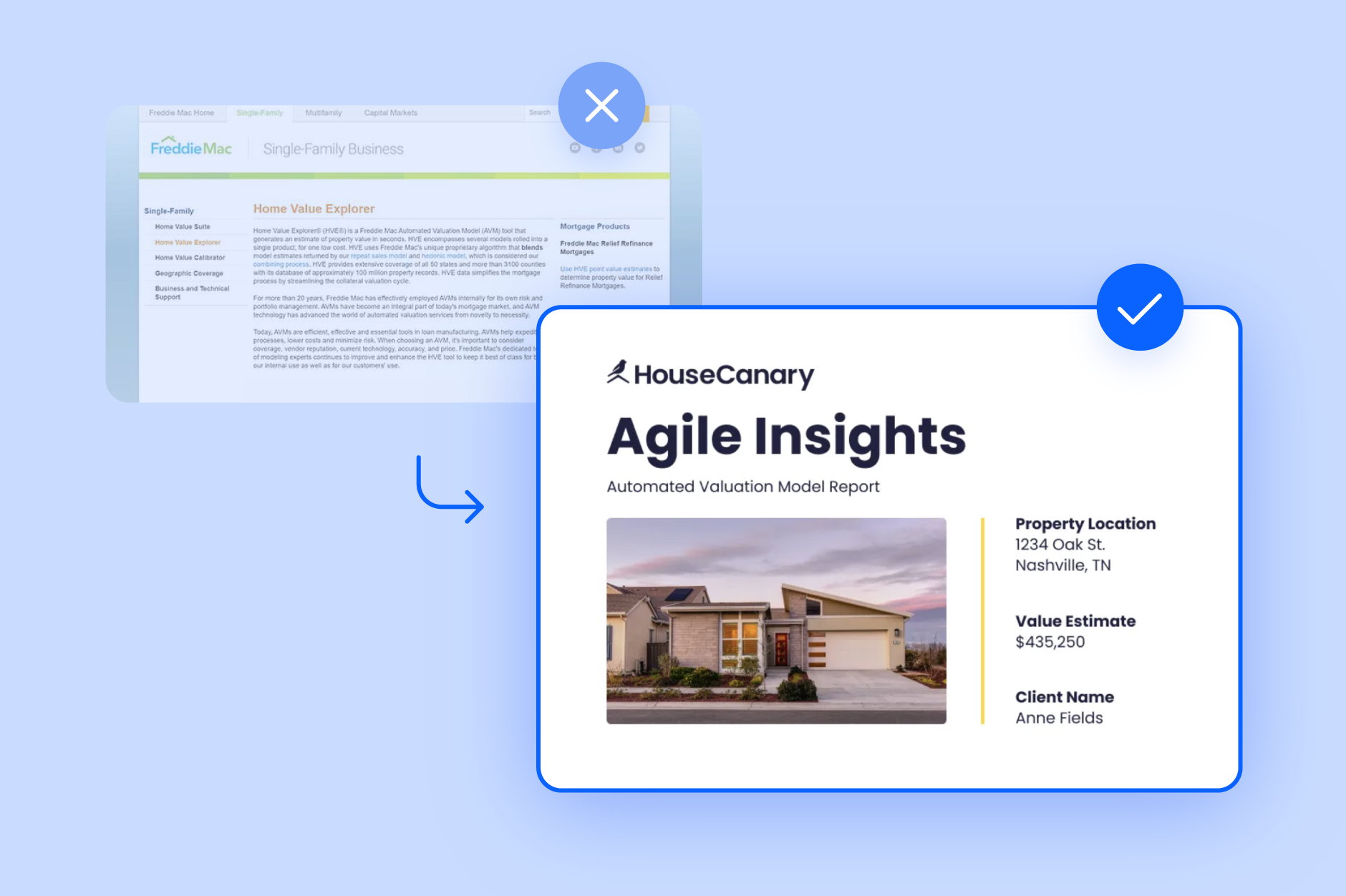
AI-powered property valuation tools can analyze vast amounts of data, including historical sales, real estate market trends, and neighborhood information, to deliver accurate and timely valuations. This eliminates guesswork and reduces reliance on manual CMA research.
Benefits include:
- Faster valuations for listings and acquisitions
- More accurate pricing that aligns with market conditions
- Better decisions through data-driven insights
HouseCanary’s automated valuation model (AVM) is a leading example, leveraging machine learning to provide highly reliable valuations that help professionals act with confidence. With a median absolute percentage error (MdAPE) of just 2.8%, HouseCanary's AVM consistently achieves industry-leading accuracy, ensuring professionals can act with confidence.
Forecasting the Market with Predictive Analytics
Predictive analytics takes AI a step further by forecasting trends in sales, inventory, and price growth. These insights allow agents and investors to anticipate market shifts, optimize acquisition strategies, and make portfolio decisions backed by data rather than intuition.
Benefits include:
- Smarter acquisition strategies
- Portfolio optimization and risk management
- Ability to anticipate and respond to market changes quickly
HouseCanary’s CanaryAI platform exemplifies this approach, providing real-time forecasts and actionable insights that help professionals stay ahead of the curve.

Automating the Back Office
AI can streamline routine administrative tasks, including lead qualification, tenant screening, and document processing. Automating these workflows helps real estate professionals save time and cut costs, freeing them to focus on client engagement and deal-making.
Benefits include:
- Faster, error-free processing of paperwork and leads
- Cost savings from reduced manual labor
- More time for strategic decision-making
Automating back-office tasks frees professionals to focus on growth, strategy, and building stronger client relationships.
Personalizing the Customer Journey
AI tools for real estate agents are enabling highly personalized experiences for clients. From property recommendations tailored to buyer preferences to virtual assistants and chatbots that respond instantly, AI improves responsiveness and can enhance client retention rates.
Benefits include:
- Improved client engagement and satisfaction
- Faster response times and tailored property suggestions
- Stronger trust and loyalty from prospective buyers and renters
Personalization helps clients feel understood and valued, creating a relationship between agents and potential leads.
Data-Driven Sales and Marketing
AI helps sales and marketing teams target campaigns more effectively, identify qualified leads, and refine pricing strategies based on market data. With insights like propensity to list or propensity to refinance, agents and lenders can focus their outreach on customers who are most likely to take action, improving efficiency and impact. By leveraging insights from customer behavior and market trends, real estate professionals can increase conversion rates and optimize marketing ROI.
Benefits include:
- Higher lead conversion rates
- Smarter marketing spend
- Data-backed pricing and promotional decisions
- More precise outreach using signals like listing or refinance likelihood
Leveraging AI for sales and marketing turns raw data into actionable insights, driving stronger results across the business.
Smarter Living with AI-Enhanced Homes
AI is extending beyond transactions into the homes themselves. AI-powered smart devices and systems improve energy efficiency, security, and overall home comfort.
Benefits include:
- Added value for buyers and long-term homeowners
- Energy and cost savings through intelligent home systems
- Enhanced security, comfort, and convenience
AI-enhanced homes deliver long-term value, making properties more attractive to buyers and improving quality of life for occupants.
Who Gains from AI in Real Estate
AI isn’t just transforming how real estate gets done; it’s creating tangible benefits for every player in the industry. These technologies speed up workflows and improve decision-making.
Here’s a look at how it impacts each sector:
- Lenders and mortgage brokers: Stronger risk assessment and fraud detection, plus AI-assisted compliance that reduces the burden of manual reporting and ensures accuracy
- Investors: Scalable insights across large or diverse portfolios, smarter acquisition strategies, and real-time alerts to shifts in the market that enable faster, more informed decisions
- Agents and brokers: Automated compliance tasks, objective valuations that reduce human bias, and faster matching of buyers with the right properties, improving efficiency and client satisfaction
- All stakeholders: Real-time market monitoring surfaces opportunities earlier and provides actionable intelligence, supporting more confident and strategic decision-making
AI levels the playing field, giving all participants faster insights, smarter strategies, and more control over real estate outcomes.
Challenges of AI in Real Estate
AI can transform how professionals analyze markets, price properties, and identify opportunities, but its adoption isn’t without hurdles. Understanding these challenges is essential for leveraging AI effectively and avoiding pitfalls, such as:
- Data quality: Incomplete or outdated data can skew valuations, but HouseCanary aggregates multiple verified sources and conducts monthly internal testing plus quarterly third-party testing to maintain accuracy and reliability.
- Ethical concerns: Bias in valuations and privacy issues must be carefully managed to ensure fairness, transparency, and trust in AI-driven decisions. HouseCanary’s study found no evidence of racial bias in its AVM and comp selection tools, showing how responsible AI design can reduce discrimination in real estate.
- Adoption hurdles: Small agencies or investors may face cost or technical barriers.
With the right tools, these challenges can be managed, and you can lean into the many benefits of adopting AI methods.
Tips to Leverage AI Across the Real Estate Industry
AI can help real estate professionals save time, make smarter decisions, and deliver better client experiences. Here are practical ways each group can put AI to work.
Agents
- Use AI tools for real estate agents for smarter lead qualification and timely follow-up.
- Generate personalized property recommendations for buyers.
- Automate client communications with chatbots or virtual assistants.
Lenders
- Apply AI for risk modeling and credit scoring.
- Streamline underwriting with automated document review.
- Monitor portfolios with predictive default alerts.
Investors
- Track market trends with Market Insights to stay ahead of market shifts.
- Use AI tools for investors to spot undervalued or off-market properties.
- Automate deal analysis and exit strategy modeling.
Whether you’re an agent, lender, or investor, AI can simplify workflows, improve accuracy, and uncover opportunities that would otherwise be missed.

AI in Real Estate 2025 Beyond
AI’s impact on real estate is only just beginning. Emerging technologies like generative AI, real-time predictive models to spot off-market leads, and hyper-local market insights will continue to transform the industry over the next five to 10 years.
HouseCanary is at the forefront of this evolution, developing platforms like CanaryAI that integrate advanced predictive analytics and hyper-local insights. These tools help professionals stay ahead of trends and make data-driven decisions in an ever-changing market.
“With CanaryAI, we’re taking predictive analytics out of spreadsheets and into real-world decisions. Whether it’s analyzing property photos, estimating after-repair values, or providing hyper-local neighborhood insights, our users get the clarity they need to move faster and smarter in any market.”
—Jeremy Sicklick, CEO and Co-Founder of HouseCanary
Transform Your Real Estate Strategy with CanaryAI
CanaryAI, HouseCanary’s next-generation AI platform, is designed to help real estate professionals make faster, smarter, and more confident decisions. By combining advanced predictive analytics, hyper-local market data, and real-time forecasting, CanaryAI delivers the insights agents, lenders, and investors need to stay ahead of shifting trends.
Recent upgrades make the platform even more powerful:
- Image-based valuations use client-uploaded photos and proprietary computer vision models to adjust for property condition, delivering sharper AVMs without extra data entry.
- Area and neighborhood queries let users zoom out from a single property to a ZIP code or city for context-aware answers.
- Instant after-repair value (ARV) estimates provide as-is vs. as-repaired comparisons directly in the chat interface, saving time when evaluating opportunities.
Explore how HouseCanary tools like CanaryAI and Property Explorer can help you make the most of AI in real estate, price with confidence, and close your next sale faster.
FAQ about AI in Real Estate
What Is the Best AI Tool for Real Estate?
CanaryAI stands out as the best AI tool for real estate because of its comprehensive nationwide data coverage, rigorous three-step verification process, and advanced AI-driven quality checks.
Its machine learning models are trained on a robust real estate dataset, combining public records, MLS, and mortgage data with continuous AI improvements. Also, HouseCanary AVMs are rigorously tested by independent third parties, consistently achieving the highest accuracy ratings in the industry.
How Can Small Firms or Solo Agents Use AI?
Even without large budgets, smaller firms and solo agents can benefit from AI by automating routine tasks, leveraging predictive insights for pricing and market trends, and using AI-powered platforms to identify qualified leads more efficiently.